7Q1
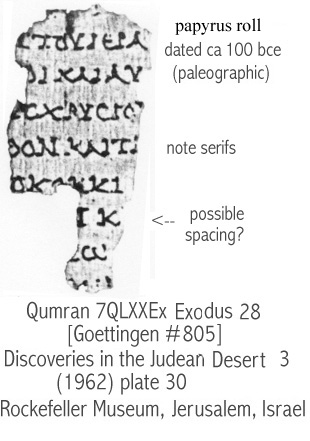
7Q1 (auch 7QLXXEx, Nr. 805 nach Rahlfs) ist das Fragment einer Papyrushandschrift aus dem 1. Jahrhundert v. Chr. Es enthält Teile aus dem 2. Buch Mose (Exodus)…
7Q1 (auch 7QLXXEx, Nr. 805 nach Rahlfs) ist das Fragment einer Papyrushandschrift aus dem 1. Jahrhundert v. Chr. Es enthält Teile aus dem 2. Buch Mose (Exodus), 28,4–7 in griechischer Übersetzung (Septuaginta). Der Text unterscheidet sich in Details von späteren Septuaginta-Handschriften und ist dem hebräischen masoretischen Text näher.
Das Fragment wurde in den 1950er Jahren in Höhle 7 bei Qumran am Toten Meer in Israel gefunden. Heute befindet es sich im Rockefeller Museum in Jerusalem, Inv. Gr. 789.
Literatur
- Maurice Baillet, Józef T. Milik, Roland de Vaux: Les petites grottes de Qumrân (= Discoveries in the Judaean desert. Band 3). Clarendon Press, Oxford 1962, S. 142 f., Nr. IV,1 (online).
Weblinks
Content Disclaimer
Informasi ini disarikan dari Wikipedia dan disajikan kembali untuk tujuan edukasi. Konten tersedia di bawah lisensi CC BY-SA 3.0. Kami tidak bertanggung jawab atas ketidakakuratan data yang bersumber dari kontribusi publik tersebut.
- The information displayed on this website is sourced in part or in whole from Wikipedia and has been adapted for the purpose of restating it. We strive to provide accurate and relevant information, however:
- There is no guarantee of absolute accuracy. Wikipedia is an open, collaborative project that can be edited by anyone, so information is subject to change.
- It is not intended to constitute professional advice. The content displayed is for informational and educational purposes only. For important decisions (e.g., medical, legal, or financial), please consult a professional.
- Content copyright. Wikipedia is licensed under the Creative Commons Attribution-ShareAlike License (CC BY-SA). This means that content may be reused with appropriate attribution and shared under a similar license.
- Responsible use. Any risk arising from the use of information from this website is entirely the responsibility of the user.