Halothiobacillus
H. neapolitanus mit Carboxysomen
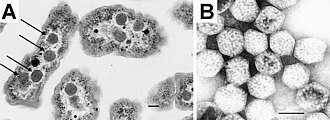
| Halothiobacillus | ||||||||||||
|---|---|---|---|---|---|---|---|---|---|---|---|---|

H. neapolitanus mit Carboxysomen | ||||||||||||
| Systematik | ||||||||||||
| ||||||||||||
| Wissenschaftlicher Name | ||||||||||||
| Halothiobacillus | ||||||||||||
| Kelly & Wood, 2000 |

Halothiobacillus ist eine Gattung gramnegativer Bakterien innerhalb der Pseudomonadota (früher Proteobacteria genannt). Die Vertreter sind stäbchenförmig und obligat aerob, das heißt, sie benötigen Sauerstoff für das Wachstum. Des Weiteren sind die Arten halophil (salzliebend).
Im Gegensatz zu anderen Mitgliedern der Ordnung Chromatiales sind die Halothiobacillus-Arten nicht zur Photosynthese fähig, sie sind vielmehr chemolithoautotroph: Die Arten gewinnen Energie durch die Oxidation von anorganischen Schwefelverbindungen zu Sulfat. Sauerstoff dient als Elektronenakzeptor und CO2 kann als einzige Kohlenstoffquelle genutzt werden. Zu den anorganischen Schwefelverbindungen zählen bei dieser Gattung Thiosulfat (S2O32−), elementarer Schwefel und Sulfide, bzw. Schwefelwasserstoff. Physiologisch werden sie somit zu den farblosen Schwefelbakterien gestellt.
Obwohl als obligat aerob bezeichnet, ist Halothiobacillus neapolitanus auch in der Lage, einige Zeit ohne Sauerstoff zu überleben. Unter diesen Umständen fermentiert dieses Bakterium die innerhalb der Zelle gespeicherte Polyglucose.
Systematik
Vor dem Jahr 2000 wurden die Mitglieder dieser Gruppe zur Gattung Thiobacillus (Familie Hydrogenophilaceae innerhalb der Klasse Beta-Proteobakterien) gezählt. Die Arten Halothiobacillus hydrothermalis und H. hydrothermalis wurden zu der im Jahr 2017 neu aufgestellten Gattung Guyparkeria transferiert. Guyparkeria wird in der ebenfalls neu aufgestellten Familie der Thioalkalibacteraceae geführt.[1]
Arten dieser Gattung sind:[2]
- Halothiobacillus kellyi Sievert et al. 2000
- Halothiobacillus neapolitanus (Parker 1957) Kelly & Wood 2000
Einzelnachweise
- ↑ Rich Boden: Reclassification of Halothiobacillus hydrothermalis and Halothiobacillus halophilus to Guyparkeria gen. nov. in the Thioalkalibacteraceae fam. nov., with emended descriptions of the genus Halothiobacillus and family Halothiobacillaceae. In: International Journal of Systematic and Evolutionary Microbiology Volume 67, Issue 10, September 2017. doi:10.1099/ijsem.0.002222
- ↑ Systematik nach J.P. Euzéby: List of Prokaryotic names with Standing in Nomenclature – Genus Halothiobacillus (Stand: 21. September 2019)
Literatur
- D. P. Kelly und A. P. Wood: Reclassification of some species of Thiobacillus to the newly designated genera Acidithiobacillus gen. nov., Halothiobacillus gen. nov. and Thermithiobacillus gen. nov. In: International Journal of Systematic and Evolutionary Microbiology 50. 2000, 489–500. doi:10.1099/00207713-50-2-511
- S. M. Sievert, T. Heidorn und J. Kuever: Halothiobacillus kellyi sp. nov., a mesophilic, obligately chemolithoautotrophic, sulfur-oxidizing bacterium isolated from a shallow-water hydrothermal vent in the Aegean Sea, and emended description of the genus Halothiobacillus. In: International Journal of Systematic and Evolutionary Microbiology 50. 2000, 1229–1237 doi:10.1099/00207713-50-3-1229
- Lesley A. Robertson und J. Gijs Kuenen: The Colorless Sulfur Bacteria. In: Martin Dworkin, Stanley Falkow, Eugene Rosenberg, Karl-Heinz Schleifer, Erko Stackebrandt (Hrsg.): The Prokaryotes, A Handbook of the Biology of Bacteria. 7 Bände, 3. Auflage, Springer-Verlag, New York u. a. O., 2006, ISBN 0-387-30740-0. Vol. 2: Ecophysiology and Biochemistry ISBN 0-387-2549-27
Content Disclaimer
Informasi ini disarikan dari Wikipedia dan disajikan kembali untuk tujuan edukasi. Konten tersedia di bawah lisensi CC BY-SA 3.0. Kami tidak bertanggung jawab atas ketidakakuratan data yang bersumber dari kontribusi publik tersebut.
- The information displayed on this website is sourced in part or in whole from Wikipedia and has been adapted for the purpose of restating it. We strive to provide accurate and relevant information, however:
- There is no guarantee of absolute accuracy. Wikipedia is an open, collaborative project that can be edited by anyone, so information is subject to change.
- It is not intended to constitute professional advice. The content displayed is for informational and educational purposes only. For important decisions (e.g., medical, legal, or financial), please consult a professional.
- Content copyright. Wikipedia is licensed under the Creative Commons Attribution-ShareAlike License (CC BY-SA). This means that content may be reused with appropriate attribution and shared under a similar license.
- Responsible use. Any risk arising from the use of information from this website is entirely the responsibility of the user.