Hull-White-Modell
In der Finanzmathematik wird unter dem Hull-White-Modell ein spezielles Momentanzinsmodell zur Beschreibung von Zinsstrukturen verstanden. Es handelt sich um eine Erweiterung des Vasicek-Modell.
Das Modell wurde erstmals 1990 von den beiden Mathematikern John C. Hull und Alan White beschrieben.[1]
Definition
Das Hull-White-Modell ist ein Momentanzinsmodell, welches den Momentanzins (engl. short rate) modelliert. Es erfüllt in seiner allgemeinsten Fassung unter dem risikoneutralen Maß folgende stochastische Differentialgleichung:


Dabei handelt es sich bei um einen Wiener-Prozess und bei und um zeitabhängige Konstanten.


Aufgrund von Schwierigkeiten bei der Kalibrierung der Parameter, hat sich in der Praxis die Fassung des Modells durchgesetzt, bei der und als zeitunabhängig vorausgesetzt werden[2][3][4], sprich es gilt:


- .

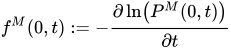
Die Parameter und lassen sich hierbei als Rückstellkraft bzw. als Volatilität des Prozesses interpretieren. kann mit diesem Ansatz so gewählt werden, dass die durch das Modell induzierte Zinsstrukturkurve zum Zeitpunkt mit der am Markt beobachteten Zinsstrukturkurve übereinstimmt. Genauer gilt in diesem Fall


- ,

wobei die aktuell am Markt beobachtete instantaneous forward rate ist.
Eigenschaften
Lösung
Die oben angegebene stochastische Differentialgleichung kann mittels der Itō-Formel gelöst werden. Die Lösung mit Anpassung an den aktuellen Marktdaten lautet
- ,

wobei .

Verteilung
ist normalverteilt mit Erwartungswert
![{\displaystyle E\left[r(t)\right]=\alpha (t)=f^{M}(0,t)+{\frac {\sigma ^{2}}{2a^{2}}}(1-e^{-at})^{2}}](https://wikimedia.org/api/rest_v1/media/math/render/svg/6e0cb194d8fb8ae86937ddbdc519aac256e08ead)
und Varianz
- .
![{\displaystyle \operatorname {Var} \left[r(t)\right]={\frac {\sigma ^{2}}{2a}}\left[1-e^{-2at}\right]}](https://wikimedia.org/api/rest_v1/media/math/render/svg/61477cd1a4b9e7fa4a9918a13b5a81fb043143eb)
Einzelnachweise
- ↑ J. Hull and A. White (1990), Pricing Interest-Rate-Derivative Securities, Review of Financial Studies (3): S. 573–592. doi:10.1093/RFS/3.4.573.
- ↑ John Hull and Alan White (1994), "Numerical procedures for implementing term structure models I," Journal of Derivatives: S. 7–16.
- ↑ J. Hull and A. White (1995), A Note on the Models of Hull and White for Pricing Options on the Term Structure, The Journal of Fixed Income: S. 97–102. doi:10.3905/jfi.1995.408139
- ↑ Damiano Brigo, Fabio Mercurio (2001). Interest Rate Models – Theory and Practice with Smile, Inflation and Credit (2nd ed. 2006 ed.). Springer Verlag: S. 72f.
Literatur
- Damiano Brigo, Fabio Mercurio (2001). Interest Rate Models – Theory and Practice with Smile, Inflation and Credit (2nd ed. 2006 ed.). Springer Verlag. ISBN 978-3-540-22149-4.
Content Disclaimer
Informasi ini disarikan dari Wikipedia dan disajikan kembali untuk tujuan edukasi. Konten tersedia di bawah lisensi CC BY-SA 3.0. Kami tidak bertanggung jawab atas ketidakakuratan data yang bersumber dari kontribusi publik tersebut.
- The information displayed on this website is sourced in part or in whole from Wikipedia and has been adapted for the purpose of restating it. We strive to provide accurate and relevant information, however:
- There is no guarantee of absolute accuracy. Wikipedia is an open, collaborative project that can be edited by anyone, so information is subject to change.
- It is not intended to constitute professional advice. The content displayed is for informational and educational purposes only. For important decisions (e.g., medical, legal, or financial), please consult a professional.
- Content copyright. Wikipedia is licensed under the Creative Commons Attribution-ShareAlike License (CC BY-SA). This means that content may be reused with appropriate attribution and shared under a similar license.
- Responsible use. Any risk arising from the use of information from this website is entirely the responsibility of the user.