Lydersen-Methode
Die Lydersen-Methode[1] ist eine Gruppenbeitragsmethode zur Abschätzung der kritischen Größen T …

Die Lydersen-Methode[1] ist eine Gruppenbeitragsmethode zur Abschätzung der kritischen Größen , und . Die Lydersen-Methode ist Vorbild für viele neuere Modelle nach Joback[2], Ambrose[3], Constantinou und Gani[4] u. a. Die Lydersen-Methode basiert im Falle der Abschätzung der kritischen Temperatur auf der Guldberg-Regel, welche die kritische Temperatur in ein Verhältnis zum Normalsiedepunkt setzt.


Bestimmungsgleichungen
- Kritische Temperatur:
- Kritischer Druck:
- Kritisches Volumen:
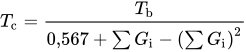
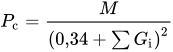
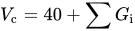
ist der Normalsiedepunkt, die molare Masse, sind Gruppenbeiträge (unterschiedlich für die einzelnen Größen) für funktionelle Gruppen eines Moleküls.


Gruppenbeiträge
| Gruppe | Gi (Tc) | Gi (Pc) | Gi (Vc) | Gruppe | Gi (Tc) | Gi (Pc) | Gi (Vc) | |
|---|---|---|---|---|---|---|---|---|
| –CH3,–CH2– | 0,020 | 0,227 | 55,0 | >CH | 0,012 | 0,210 | 51,0 | |
| –C< | — | 0,210 | 41,0 | =CH2,=CH | 0,018 | 0,198 | 45,0 | |
| =C<,=C= | — | 0,198 | 36,0 | =C–H,=C– | 0,005 | 0,153 | 36,0 | |
| –CH2–(Ring) | 0,013 | 0,184 | 44,5 | >CH– (Ring) | 0,012 | 0,192 | 46,0 | |
| >C< (Ring) | −0,007 | 0,154 | 31,0 | =CH–,=C<,=C=(Ring) | 0,011 | 0,154 | 37,0 | |
| –F | 0,018 | 0,224 | 18,0 | –Cl | 0,017 | 0,320 | 49,0 | |
| –Br | 0,010 | 0,500 | 70,0 | –I | 0,012 | 0,830 | 95,0 | |
| –OH | 0,082 | 0,060 | 18,0 | –OH(Aromat) | 0,031 | −0,020 | 3,0 | |
| –O– | 0,021 | 0,160 | 20,0 | –O– (Ring) | 0,014 | 0,120 | 8,0 | |
| >C=O | 0,040 | 0,290 | 60,0 | >C=O (Ring) | 0,033 | 0,200 | 50,0 | |
| HC=O– | 0,048 | 0,330 | 73,0 | –COOH | 0,085 | 0,400 | 80,0 | |
| -COO- | 0,047 | 0,470 | 80,0 | -NH2 | 0,031 | 0,095 | 28,0 | |
| >NH | 0,031 | 0,135 | 37,0 | >NH(Ring) | 0,024 | 0,090 | 27,0 | |
| >N | 0,014 | 0,170 | 42,0 | >N–(Ring) | 0,007 | 0,130 | 32,0 | |
| –CN | 0,060 | 0,360 | 80,0 | -NO2 | 0,055 | 0,420 | 78,0 | |
| –SH,–S– | 0,015 | 0,270 | 55,0 | –S– (Ring) | 0,008 | 0,240 | 45,0 | |
| =S | 0,003 | 0,240 | 47,0 | >Si< | 0,030 | 0,540 | — | |
| –B< | 0,030 | — | — |
Beispielrechnung

Aceton wird in zwei unterschiedliche Fragmente zerlegt, eine Carbonylgruppe und zwei Methylgruppen. Für das kritische Volumen ergibt sich folgende Rechnung:

In der Literatur[5] finden sich Werte von 215,90 cm3,[6] 230,5 cm3[7] und 209,0 cm3.[8]
Einzelnachweise
- ↑ Lydersen a.L., „Estimation of Critical Properties of Organic Compounds“, University of wisconsin College Engineering, Eng. Exp. Stn. Rep. 3, Madison, Wisconsin
- ↑ K. G Joback, R. C Reid: Estimation of pure-component properties from group-contributions. In: Chemical Engineering Communications. Band 57, Nr. 1, 1987, S. 233–243.
- ↑ D. Ambrose, Teddington (England). Div. of Chemical Standards National Physical Lab.: Correlation and estimation of vapour-liquid critical properties. Part 1: Critical temperatures of organic compounds. Rep.No. 92. National Physical Lab., Teddington (England). Div. of Chemical Standards, 1978, S. 1–35.
- ↑ Leonidas Constantinou, Rafiqul Gani: New group contribution method for estimating properties of pure compounds. In: AIChE Journal. Band 40, Nr. 10, Oktober 1994, S. 1697–1710, doi:10.1002/aic.690401011.
- ↑ Dortmunder Datenbank
- ↑ A. N. Campbell, R. M. Chatterjee: The critical constants and orthobaric densities of acetone, chloroform, benzene, and carbon tetrachloride. In: Canadian Journal of Chemistry. Band 47, Nr. 20, 15. Oktober 1969, S. 3893–3898, doi:10.1139/v69-646.
- ↑ W. Herz, E. Neukirch: On Knowledge of the Critical State. In: Z.Phys.Chem.(Leipzig). Band 104, 1923, S. 433–450.
- ↑ Kenneth A. Kobe, Horace R. Crawford, Robert W. Stephenson: Industrial Design Data – Critical Properties and Vapor Presesures of Some Ketones. In: Industrial & Engineering Chemistry. Band 47, Nr. 9, September 1955, S. 1767–1772, doi:10.1021/ie50549a025.
Content Disclaimer
Informasi ini disarikan dari Wikipedia dan disajikan kembali untuk tujuan edukasi. Konten tersedia di bawah lisensi CC BY-SA 3.0. Kami tidak bertanggung jawab atas ketidakakuratan data yang bersumber dari kontribusi publik tersebut.
- The information displayed on this website is sourced in part or in whole from Wikipedia and has been adapted for the purpose of restating it. We strive to provide accurate and relevant information, however:
- There is no guarantee of absolute accuracy. Wikipedia is an open, collaborative project that can be edited by anyone, so information is subject to change.
- It is not intended to constitute professional advice. The content displayed is for informational and educational purposes only. For important decisions (e.g., medical, legal, or financial), please consult a professional.
- Content copyright. Wikipedia is licensed under the Creative Commons Attribution-ShareAlike License (CC BY-SA). This means that content may be reused with appropriate attribution and shared under a similar license.
- Responsible use. Any risk arising from the use of information from this website is entirely the responsibility of the user.