NGC 248
| Emissionsnebel | ||
|---|---|---|
| NGC 248 | ||
 | ||
| JWST-NIR-Aufnahme | ||
  | ||
| AladinLite | ||
| Sternbild | Tukan | |
| Position Äquinoktium: J2000.0, Epoche: J2000.0 | ||
| Rektaszension | 00h 46m 19,6s [1] | |
| Deklination | −73° 23′ 21″ [1] | |
| Erscheinungsbild | ||
| Winkelausdehnung | 1′,3 × 1′,0[1] | |
| Ionisierende Quelle | ||
| Physikalische Daten
| ||
| Zugehörigkeit | Kleine Magellansche Wolke[2] | |
| Entfernung | 200.000 Lj | |
| Geschichte | ||
| Entdeckung | John Herschel | |
| Datum der Entdeckung | 11. April 1834 | |
| Katalogbezeichnungen | ||
| NGC 248 • GC 133 • h 2344 • ESO 29-EN8 | ||
NGC 248 ist ein Emissionsnebel im Sternbild Tukan. Er wurde am 11. April 1834 von dem britischen Astronomen John Frederick William Herschel entdeckt.[3]
Der Nebel befindet sich in der Kleinen Magellanschen Wolke.
-
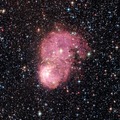 HST-Aufnahme
Weblinks
Quellen
Content Disclaimer
Informasi ini disarikan dari Wikipedia dan disajikan kembali untuk tujuan edukasi. Konten tersedia di bawah lisensi CC BY-SA 3.0. Kami tidak bertanggung jawab atas ketidakakuratan data yang bersumber dari kontribusi publik tersebut.
- The information displayed on this website is sourced in part or in whole from Wikipedia and has been adapted for the purpose of restating it. We strive to provide accurate and relevant information, however:
- There is no guarantee of absolute accuracy. Wikipedia is an open, collaborative project that can be edited by anyone, so information is subject to change.
- It is not intended to constitute professional advice. The content displayed is for informational and educational purposes only. For important decisions (e.g., medical, legal, or financial), please consult a professional.
- Content copyright. Wikipedia is licensed under the Creative Commons Attribution-ShareAlike License (CC BY-SA). This means that content may be reused with appropriate attribution and shared under a similar license.
- Responsible use. Any risk arising from the use of information from this website is entirely the responsibility of the user.