Posterior predictive distribution
In der Bayesschen Statistik ist die Posterior predictive distribution eines statistischen Modells[1] die bedingte Wahrscheinlichkeitsdichte neuer, unbeobachteter Werte , gegeben alle bisherigen Beobachtungen . Man erhält sie durch Parameter-Integration der bedingten Dichte mit der Posterior-Dichte .


Definition
Die Posterior predictive distribution ist definiert als
![{\displaystyle p({\tilde {x}}|\mathbf {x} )=\int _{\Theta }p({\tilde {x}}|\theta )\,p(\theta |\mathbf {x} )\operatorname {d} \!\theta =\mathbb {E} _{\theta |\mathbf {x} }[p({\tilde {x}}|\theta )],}](https://wikimedia.org/api/rest_v1/media/math/render/svg/6afe8428838a43c6fa4e7178a26316f0f759d474)
wobei der Parameterraum und die Posterior-Dichte ist. Die Gleichheit lässt sich mit dem Gesetz der totalen Wahrscheinlichkeit direkt sehen.

Die Posterior predictive distribution spielt zum Beispiel im Rahmen der Gauß-Prozess-Regression eine wichtige Rolle.
Abgrenzung gegenüber der Prior predictive distribution
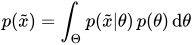
Die Prior predictive distribution lässt die beobachteten Daten außer Acht:
Bootstrap predictive distribution
Die Posterior predictive distribution kann durch Anwendung der Bootstrap predictive distribution genähert werden, wobei per Bootstrapping-Verfahren aus der empirischen Verteilungsfunktion gezogene Stichproben sind.[2][3]


Siehe auch
Einzelnachweise
- ↑ Gaussian Process Regression Analysis for Functional Data. ISBN 978-1-4398-3774-0.
- ↑ Tadayoshi Fushiki: Bayesian bootstrap prediction. „[…] the bootstrap predictive distribution is considered to be an approximation of the Bayesian predictive distribution […]“ doi:10.1016/j.jspi.2009.06.007.
- ↑ Tadayoshi Fushiki, Fumiyasu Komaki, Kazuyuki Aihara: Nonparametric bootstrap prediction. 2005, doi:10.3150/bj/1116340296.
Content Disclaimer
Informasi ini disarikan dari Wikipedia dan disajikan kembali untuk tujuan edukasi. Konten tersedia di bawah lisensi CC BY-SA 3.0. Kami tidak bertanggung jawab atas ketidakakuratan data yang bersumber dari kontribusi publik tersebut.
- The information displayed on this website is sourced in part or in whole from Wikipedia and has been adapted for the purpose of restating it. We strive to provide accurate and relevant information, however:
- There is no guarantee of absolute accuracy. Wikipedia is an open, collaborative project that can be edited by anyone, so information is subject to change.
- It is not intended to constitute professional advice. The content displayed is for informational and educational purposes only. For important decisions (e.g., medical, legal, or financial), please consult a professional.
- Content copyright. Wikipedia is licensed under the Creative Commons Attribution-ShareAlike License (CC BY-SA). This means that content may be reused with appropriate attribution and shared under a similar license.
- Responsible use. Any risk arising from the use of information from this website is entirely the responsibility of the user.