Problem von Bernstein
In der Mathematik bezeichnet man als Problem von Bernstein die Fragestellung, ob der Graph einer Funktion f : …
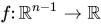
In der Mathematik bezeichnet man als Problem von Bernstein die Fragestellung, ob der Graph einer Funktion nur dann eine Minimalfläche im ist, wenn die Funktion affin ist. Die Antwort ist positiv für , aber negativ für .


Mathematische Formulierung
Für eine Funktion ist ihr Graph eine Hyperfläche im und er ist genau dann eine Minimalfläche, wenn eine Lösung der Differentialgleichung

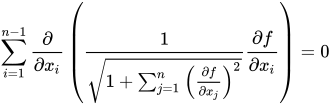
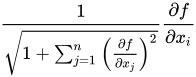
ist. Offensichtlich sind alle affinen Funktionen Lösungen dieser Differentialgleichung, weil in diesem Fall eine Konstante ist. Das Problem von Bernstein fragt, ob es darüber hinaus noch weitere Lösungen dieser Differentialgleichung gibt.

Historie
- Für wurde das Problem 1914 von Sergei Natanowitsch Bernstein gelöst.[1]
- Für wurde das Problem 1965 von Ennio De Giorgi gelöst.[2]
- Für wurde das Problem 1966 von Frederick Almgren gelöst.[3]
- Für wurde das Problem 1968 von James Simons gelöst.[4]
- Für bewiesen Enrico Bombieri, Ennio De Giorgi und Enrico Giusti aufbauend auf der Arbeit von James Simons, dass der Satz von Bernstein nicht zutrifft.[5]


Einzelnachweise
- ↑ S. N. Bernstein, Sur une théorème de géometrie et ses applications aux équations dérivées partielles du type elliptique, Comm. Soc. Math. Kharkov, Band 15, 1915–1917, S. 38–45
- ↑ E. De Giorgi, Una estensione del teorema di Bernstein. Ann. Scuola Norm. Sup. Pisa (3) 19, 79–85, 1965.
- ↑ F. Almgren, Some interior regularity theorems for minimal surfaces and an extension of the Bernstein's theorem, Ann. of Math., Band 85, 1966, S. 277–292
- ↑ J. Simons, Minimal varieties in Riemannian Manifolds, Annals of Mathematics, Band 88, 1968, S. 62–105.
- ↑ E. Bombieri, E. De Giorgi, E. Giusti, Minimal cones and the Bernstein problem, Inventiones Mathematicae 7 (1969) 243–268
Content Disclaimer
Informasi ini disarikan dari Wikipedia dan disajikan kembali untuk tujuan edukasi. Konten tersedia di bawah lisensi CC BY-SA 3.0. Kami tidak bertanggung jawab atas ketidakakuratan data yang bersumber dari kontribusi publik tersebut.
- The information displayed on this website is sourced in part or in whole from Wikipedia and has been adapted for the purpose of restating it. We strive to provide accurate and relevant information, however:
- There is no guarantee of absolute accuracy. Wikipedia is an open, collaborative project that can be edited by anyone, so information is subject to change.
- It is not intended to constitute professional advice. The content displayed is for informational and educational purposes only. For important decisions (e.g., medical, legal, or financial), please consult a professional.
- Content copyright. Wikipedia is licensed under the Creative Commons Attribution-ShareAlike License (CC BY-SA). This means that content may be reused with appropriate attribution and shared under a similar license.
- Responsible use. Any risk arising from the use of information from this website is entirely the responsibility of the user.