Romphaia
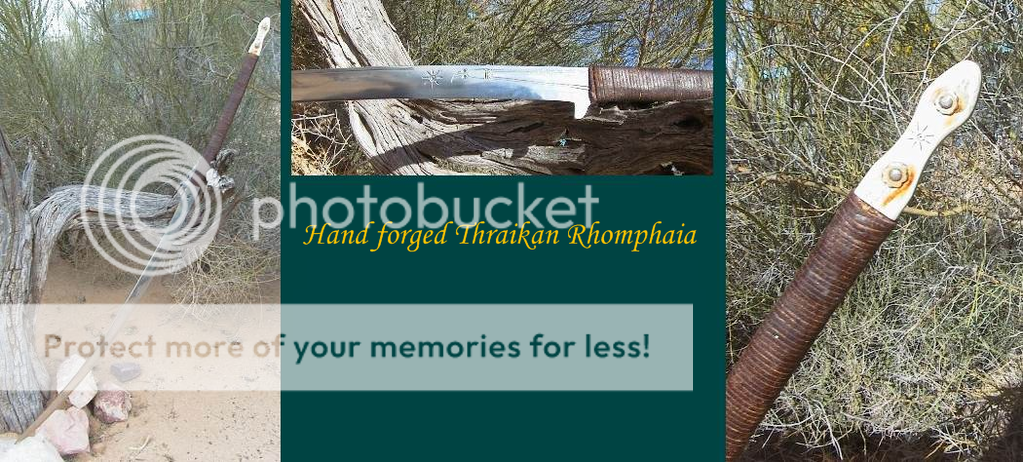
Die Romphaia (zu altgriechisch ρομφαία, auch Romphaea oder Rumpia genannt) war ein sichelartiges schweres und außergewöhnlich langes (bis über 2 m) Br…

| Romphaia | |
|---|---|

| |
| Angaben | |
| Waffenart: | Schwert, Sichelschwert |
| Bezeichnungen: | Romphaia, thrakische Romphaia |
| Verwendung: | Waffe |
| Gesamtlänge: | etwa bis 200 cm |
| Griffstück: | Holz, Leder |
| Listen zum Thema | |
Die Romphaia (zu altgriechisch ρομφαία, auch Romphaea oder Rumpia genannt) war ein sichelartiges schweres und außergewöhnlich langes (bis über 2 m) Breitschwert der Thraker.
Beschreibung
Die Romphaia hat eine nach innen gebogene Krümmung und ist auf der Innenseite oder beiden Seiten geschliffen. Es wurde ungefähr im Jahr 400 vor Christus erfunden und wurde beidhändig geführt. Es hatte vernichtende Wirkung, vor allem vom Pferd aus. Mit der Romphaia konnten die Thraker durch weit ausholende Bewegungen Köpfe und Arme ihrer Gegner abhacken und angeblich sogar Körper zweiteilen. Die Romphaia ähnelte der dakischen Falx.
Weblinks
Literatur
- John Pairman Brown: Israel and Hellas. Band 3: The Legacy of Iranian Imperialism and the Individual. de Gruyter, Berlin u. a. 2001, ISBN 3-11-016882-0, S. 527 (Beihefte zur Zeitschrift für die alttestamentliche Wissenschaft 299).
- Paul Couissin: Les institutions militaires et navales. Société d'édition Les belles Lettres, Paris 1932 (Lavie publique et privée des anciens grecs 8).
- Arnold M. Snodgrass: Armi ed armature dei Greci. L'Erma di Bretschneider, Rom 1991, ISBN 88-7062-726-8, S. 177 (Societa e cultura greca e romana 1).
- Christopher Webber, Angus McBride: The Thracians, 700 BC – AD 46. Osprey Publishing, Oxford 2001, ISBN 1-8417-6329-2 (Men-at-arms series 360).
Content Disclaimer
Informasi ini disarikan dari Wikipedia dan disajikan kembali untuk tujuan edukasi. Konten tersedia di bawah lisensi CC BY-SA 3.0. Kami tidak bertanggung jawab atas ketidakakuratan data yang bersumber dari kontribusi publik tersebut.
- The information displayed on this website is sourced in part or in whole from Wikipedia and has been adapted for the purpose of restating it. We strive to provide accurate and relevant information, however:
- There is no guarantee of absolute accuracy. Wikipedia is an open, collaborative project that can be edited by anyone, so information is subject to change.
- It is not intended to constitute professional advice. The content displayed is for informational and educational purposes only. For important decisions (e.g., medical, legal, or financial), please consult a professional.
- Content copyright. Wikipedia is licensed under the Creative Commons Attribution-ShareAlike License (CC BY-SA). This means that content may be reused with appropriate attribution and shared under a similar license.
- Responsible use. Any risk arising from the use of information from this website is entirely the responsibility of the user.