Thoma-Simplex
Ein Thoma-Simplex ist in der Mathematik ein unendlich-dimensionales Simplex, das man in der Darstellungstheorie unendlicher Gruppen benötigt. Das Simplex ist e…

Ein Thoma-Simplex ist in der Mathematik ein unendlich-dimensionales Simplex, das man in der Darstellungstheorie unendlicher Gruppen benötigt. Das Simplex ist ein geschlossener Unterraum des abzählbar unendlichen Produktraumes
und besteht aus Paaren von unendlichen reellen Folgen.
Das Thoma-Simplex ist nach Elmar Thoma benannt, der 1964 die abzählbar unendliche symmetrische Gruppe

untersuchte und eine Klassifikation aller Charaktere durch Elemente des Thoma-Simplex fand.[1][2]

Thoma-Simplex
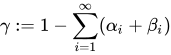
Ein Thoma-Simplex ist die Menge der Paare bestehend aus reellen Folgen , so dass[3][4]



gilt. Weiter definiert man .
Einzelnachweise
- ↑ Elmar Thoma: Die unzerlegbaren, positiv-definiten Klassenfunktionen der abzählbar unendlichen, symmetrischen Gruppe. In: Mathematische Zeitschrift. Band 85, 1964, S. 40–61 (eudml.org).
- ↑ Andrei Okounkov: On the representations of the infinite symmetric group. Hrsg.: arXiv. 1998, doi:10.48550/ARXIV.MATH/9803037, arxiv:math/9803037 (PhD-Thesis).
- ↑ Sergei Kerov, Grigori Olshanski und Anatoly Vershik: Harmonic analysis on the infinite symmetric group. In: Springer Science and Business Media (Hrsg.): Inventiones mathematicae. Band 158, Nr. 3, 2004, S. 551--642, arxiv:math/0312270.
- ↑ G. I. Olshanski: The Topological Support of the z-Measures on the Thoma Simplex. Hrsg.: arXiv. 2018, doi:10.48550/ARXIV.1809.07125, arxiv:1809.07125 [abs].
Content Disclaimer
Informasi ini disarikan dari Wikipedia dan disajikan kembali untuk tujuan edukasi. Konten tersedia di bawah lisensi CC BY-SA 3.0. Kami tidak bertanggung jawab atas ketidakakuratan data yang bersumber dari kontribusi publik tersebut.
- The information displayed on this website is sourced in part or in whole from Wikipedia and has been adapted for the purpose of restating it. We strive to provide accurate and relevant information, however:
- There is no guarantee of absolute accuracy. Wikipedia is an open, collaborative project that can be edited by anyone, so information is subject to change.
- It is not intended to constitute professional advice. The content displayed is for informational and educational purposes only. For important decisions (e.g., medical, legal, or financial), please consult a professional.
- Content copyright. Wikipedia is licensed under the Creative Commons Attribution-ShareAlike License (CC BY-SA). This means that content may be reused with appropriate attribution and shared under a similar license.
- Responsible use. Any risk arising from the use of information from this website is entirely the responsibility of the user.