Thomson-Problem
Beim Thomson-Problem sollen n Elektronen so auf der Oberfläche einer Einheitskugel verteilt werden, dass das gesamte elektrostatische Potential, das sich durch die Coulombkraft einstellt, sein Minimum annimmt. Der Physiker Joseph John Thomson formulierte dieses Problem 1904[1], nachdem er sein Atommodell entwickelte.
Mathematisch ist es eines der Smale-Probleme.
Mathematische Beschreibung
Das elektrostatische Potential , das zwischen zwei Elektronen entsteht, kann mit dem coulombschen Gesetz beschrieben werden.

- .
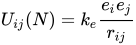
Dabei sind und die Ladungen der Elektronen, ist die Coulombkonstante (gegeben durch ; ist die elektrische Feldkonstante) und ist der Abstand der beiden Elektronen zueinander. Zur Vereinfachung des Problems können und gesetzt werden.


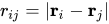


Bei einer Konfiguration von Elektronen stellt sich dann das Potential

- .
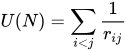
ein. Ziel ist es nun, diejenige Form zu finden, bei der dieses Gesamtpotential ein Minimum annimmt. Das Finden einer Lösung geschieht meist durch numerische Verfahren.
Bekannte Lösungen
- : Für nur ein einziges Elektron ist die Lösung trivial, da sich, egal wo sich das Elektron auf der Kugeloberfläche befindet, immer dasselbe Potential einstellt.

- : Bei zwei Elektronen ist das Potentialminimum dann vorhanden, wenn sie sich diametral gegenüber befinden (z. B. Nord- und Südpol).

- : Bei drei Elektronen bildet die Konfiguration ein gleichseitiges Dreieck auf einem Großkreis der Kugel.[2]

- : Die vier Elektronen bilden ein Tetraeder.

- : Für fünf Elektronen wurde 2010 ein computergestützter Beweis erbracht, wonach diese eine dreieckige Bipyramide bilden.[3]


Verwandte wissenschaftliche Probleme
Das Problem von Thomson spielt eine Rolle in anderen physikalischen Modellen wie zum Beispiel Elektronenblasen oder die Oberflächenbeschaffenheit von flüssigen Metalltropfen in Paul-Fallen.
Literatur
- Carlos Beltrán: The State of the Art in Smale's 7th Problem. In: Felipe Cucker, Teresa Krick, Allan Pinkus, Agnes Szanto (Hrsg.): Foundations of Computational Mathematics. Budapest 2011 (= London Mathematical Society. Lecture Note Series. 403). Cambridge University Press, Cambridge u. a. 2013, ISBN 978-1-107-60407-0, S. 1–15.
- L. L. Whyte: Unique arrangements of points on a sphere. In: American Mathematical Monthly. Bd. 59, Nr. 9, 1952, S. 606–611, JSTOR:2306764.
- Edward B. Saff, Arno B. J. Kuijlaars: Distributing many points on a sphere. In: The Mathematical Intelligencer. Bd. 19, Nr. 1, 1997, S. 5–11, doi:10.1007/BF03024331
Weblinks
Einzelnachweise
- ↑ Joseph J. Thomson: On the structure of the atom: an investigation of the stability and periods of oscillation of a number of corpuscles arranged at equal intervals around the circumference of a circle; with application of the results to the theory of atomic structure. In: The London, Edinburgh, and Dublin Philosophical Magazine and Journal of Science. Series 6, Bd. 7, Nr. 39, 1904, ZDB-ID 5450-1, S. 237–265, doi:10.1080/14786440409463107.
- ↑ Ludwig Föppl: Stabile Anordnungen von Elektronen im Atom. In: Journal für die reine und angewandte Mathematik. Bd. 141, 1912, S. 251–302, (Digitalisat).
- ↑ Richard Evan Schwartz: The 5 Electron Case of Thomson’s Problem. In: Mathematical Physics. 21. Januar 2010, arxiv:1001.3702.
- ↑ V. A. Yudin: The minimum of potential energy of a System of point charges. In: Discrete Mathematics and Applications. Band 3, Nr. 1, 2009, S. 75–82, doi:10.1515/dma.1993.3.1.75.
- ↑ Nikolay N. Andreev: An extremal property of the icosahedron. In: East Journal on Approximations. Bd. 2, Nr. 4, 1996, ISSN 1310-6236, S. 459–462, MR 97m:52022, Zbl 0877.51021.
Content Disclaimer
Informasi ini disarikan dari Wikipedia dan disajikan kembali untuk tujuan edukasi. Konten tersedia di bawah lisensi CC BY-SA 3.0. Kami tidak bertanggung jawab atas ketidakakuratan data yang bersumber dari kontribusi publik tersebut.
- The information displayed on this website is sourced in part or in whole from Wikipedia and has been adapted for the purpose of restating it. We strive to provide accurate and relevant information, however:
- There is no guarantee of absolute accuracy. Wikipedia is an open, collaborative project that can be edited by anyone, so information is subject to change.
- It is not intended to constitute professional advice. The content displayed is for informational and educational purposes only. For important decisions (e.g., medical, legal, or financial), please consult a professional.
- Content copyright. Wikipedia is licensed under the Creative Commons Attribution-ShareAlike License (CC BY-SA). This means that content may be reused with appropriate attribution and shared under a similar license.
- Responsible use. Any risk arising from the use of information from this website is entirely the responsibility of the user.