WEIZAC
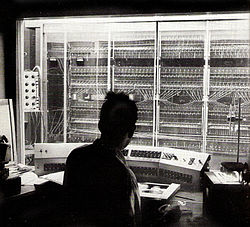
WEIZAC (Weizmann Automatic Calculator) ist der Name des ersten Computers in Israel und auch einer der ersten Großrechner weltweit. Er wurde 1954 bis 1955 am We…

_Front.jpg)
WEIZAC (Weizmann Automatic Calculator) ist der Name des ersten Computers in Israel und auch einer der ersten Großrechner weltweit. Er wurde 1954 bis 1955 am Weizmann-Institut für Wissenschaften gebaut und basierte auf der von John von Neumann entwickelten IAS-Architektur (Institute for Advanced Study). Statt 1 kB Speicher wie am IAS-Computer hatte er allerdings 4 kB. Ende 1955 führte er seine ersten Rechnungen aus. WEIZAC war bis zum 29. Dezember 1963 in Betrieb und wurde von GOLEM abgelöst.
WEIZAC wurde mit einem Budget von $50.000 entwickelt, einem Fünftel des Gesamtetats des Weizmann-Instituts. Zum Komitee am IAS, das sich für das Projekt aussprach, gehörte u. a. auch Albert Einstein und John von Neumann selbst. Die Entwicklung von WEIZAC wurde von Gerald Estrin geleitet, beteiligt waren Estrins Frau Thelma (eine Elektroingenieurin), Chaim L. Pekeris und Aviezri Fraenkel und andere (insgesamt rund ein Dutzend Personen). Der Angewandte Mathematiker Pekeris, von dem die Initiative ausging, war in der Folge auch einer der Hauptnutzer. Der WEIZAC wurde auch vom israelischen Militär benutzt, diese hatten allerdings nur wöchentlich eine Stunde (später auf zwei erweitert) Nutzerzeit.
Der WEIZAC existiert noch heute im Weizmann-Institut.
Literatur
- Gerald Estrin The WEIZAC Years (1954-1963), IEEE Annals of the History of Computing, Band 13, 1991, S. 317–339
Weblinks

Content Disclaimer
Informasi ini disarikan dari Wikipedia dan disajikan kembali untuk tujuan edukasi. Konten tersedia di bawah lisensi CC BY-SA 3.0. Kami tidak bertanggung jawab atas ketidakakuratan data yang bersumber dari kontribusi publik tersebut.
- The information displayed on this website is sourced in part or in whole from Wikipedia and has been adapted for the purpose of restating it. We strive to provide accurate and relevant information, however:
- There is no guarantee of absolute accuracy. Wikipedia is an open, collaborative project that can be edited by anyone, so information is subject to change.
- It is not intended to constitute professional advice. The content displayed is for informational and educational purposes only. For important decisions (e.g., medical, legal, or financial), please consult a professional.
- Content copyright. Wikipedia is licensed under the Creative Commons Attribution-ShareAlike License (CC BY-SA). This means that content may be reused with appropriate attribution and shared under a similar license.
- Responsible use. Any risk arising from the use of information from this website is entirely the responsibility of the user.