Notopithecus adapinus
| †Notopithecus adapinus | ||
|---|---|---|
| Rango temporal: Eoceno superior | ||
 silueta de Notopithecus | ||
| Taxonomía | ||
| Reino: | Animalia | |
| Filo: | Chordata | |
| Subfilo: | Vertebrata | |
| Clase: | Mammalia | |
| Infraclase: | Placentalia | |
| Superorden: |
Laurasiatheria Meridiungulata | |
| Orden: | Notoungulata† | |
| Suborden: | Typotheria† | |
| Familia: | Interatheriidae | |
| Subfamilia: | Notopithecinae | |
| Género: | Notopithecus' | |
| Sinonimia | ||
| ||
Notopithecus adapinus fue un notoungulado basal de la familia Interatheriidae, que vivió durante la edad mamífero Casamayorense en Patagonia, Argentina. Era un animal de pequeño tamaño entre 1 y 2 kg de masa corporal.[1][2] Dentro de los notopitecinos, es la especie mejor conocida, habiéndose hallado un esqueleto completo en la localidad de Valle Hermoso, Provincia del Chubut, Argentina. Era un animal herbívoro, con muelas braquiodontes y dentición completa, probablemente plantígrado.[3]
El nombre del género significa "simio del sur" (notos= sur; pithecus= simio, mono) y el epíteto específico hace referencia a la familia Adapidae, una familia extinta de primates de América del Norte a los que Florentino Ameghino consideró que estaban relacionados.[4]
Galería de imágenes
-
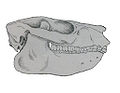 Cráneo de Notopithecus
Referencias
- ↑ Elissamburu, Andrea (2012). «Estimación de la masa corporal en géneros del Orden Notoungulata». Estudios Geológicos 68 (1): 91-111. doi:10.3989/egeol.40336.133.
- ↑ Scarano, Alejo C.; Carlini, Alfredo A.; Illius, Andrew W. (2011-03). «Interatheriidae (Typotheria; Notoungulata), body size and paleoecology characterization». Mammalian Biology (en inglés) 76 (2): 109-114. doi:10.1016/j.mambio.2010.08.001. Consultado el 5 de mayo de 2020.
- ↑ Vera, Bárbara (de septiembre de 2012). «Postcranial morphology of Notopithecus Ameghino, 1897 (Notoungulata, Interatheriidae) from the middle Eocene of Patagonia, Argentina». Journal of Vertebrate Paleontology 32 (5): 1135-1148. doi:10.1080/02724634.2012.694320.
- ↑ Croft, Darin A.,. Horned armadillos and rafting monkeys : the fascinating fossil mammals of South America. ISBN 978-0-253-02094-9. OCLC 951975229. Consultado el 4 de mayo de 2020.
| Control de autoridades |
|
|---|

 Datos: Q93267043
Content Disclaimer
Informasi ini disarikan dari Wikipedia dan disajikan kembali untuk tujuan edukasi. Konten tersedia di bawah lisensi CC BY-SA 3.0. Kami tidak bertanggung jawab atas ketidakakuratan data yang bersumber dari kontribusi publik tersebut.
- The information displayed on this website is sourced in part or in whole from Wikipedia and has been adapted for the purpose of restating it. We strive to provide accurate and relevant information, however:
- There is no guarantee of absolute accuracy. Wikipedia is an open, collaborative project that can be edited by anyone, so information is subject to change.
- It is not intended to constitute professional advice. The content displayed is for informational and educational purposes only. For important decisions (e.g., medical, legal, or financial), please consult a professional.
- Content copyright. Wikipedia is licensed under the Creative Commons Attribution-ShareAlike License (CC BY-SA). This means that content may be reused with appropriate attribution and shared under a similar license.
- Responsible use. Any risk arising from the use of information from this website is entirely the responsibility of the user.