Tagundaing
Tagundaing (en birmano: တံခွန်တိုင်) se refiere a una columna de la victoria ornamentada o asta de bandera, típicamente de 60 a 80 pies (18 a 24 m), que se encuentra dentro de los terrenos de pagodas y kyaungs (monasterios) budistas birmanos.[1][2] Estas columnas ornamentadas se levantaron dentro de los recintos religiosos para celebrar la sumisión de los nats (espíritus animistas locales) al Dharma, la doctrina budista e inspirados en los Pilares de Ashoka.[1]

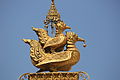
Un hintha mítico (o más raramente un kinnara) se encuentra generalmente posado sobre la columna, mientras que la base de la columna puede estar decorada con Thagyamin.[1][2] Vasudhara, la diosa de la tierra, también se puede encontrar en la base.[1]
Ejemplos
-
 Tagundaing en la Pagoda Hpaung Daw U inspirada en los Pilares de Ashoka
 -

-

-

-

-
.jpg)
.jpg)

.jpg)


Véase también
- Anexo:Edictos de Ashoka
- Arquitectura de los templos hinduistas
- Historia de la metalurgia en el subcontinente indio
- Pilar de hierro de Delhi
- Pilar de hierro de Dhar
- Pilares de Ashoka
- Producción de hierro en la antigüedad
Referencias
 Wikimedia Commons alberga una categoría multimedia sobre Tagundaing.

- ↑ a b c d «Tagundaing». Burma Collections. Center for Burma Studies, Northern Illinois University. Archivado desde el original el 5 de septiembre de 2013. Consultado el 7 de octubre de 2013.
- ↑ a b Ferrars, Max; Bertha Ferrars (1900). Burma. S. Low, Marston & Company. pp. 37.
| Control de autoridades |
|
|---|

 Datos: Q17060793
- Multimedia: Tagundaing / Q17060793
Content Disclaimer
Informasi ini disarikan dari Wikipedia dan disajikan kembali untuk tujuan edukasi. Konten tersedia di bawah lisensi CC BY-SA 3.0. Kami tidak bertanggung jawab atas ketidakakuratan data yang bersumber dari kontribusi publik tersebut.
- The information displayed on this website is sourced in part or in whole from Wikipedia and has been adapted for the purpose of restating it. We strive to provide accurate and relevant information, however:
- There is no guarantee of absolute accuracy. Wikipedia is an open, collaborative project that can be edited by anyone, so information is subject to change.
- It is not intended to constitute professional advice. The content displayed is for informational and educational purposes only. For important decisions (e.g., medical, legal, or financial), please consult a professional.
- Content copyright. Wikipedia is licensed under the Creative Commons Attribution-ShareAlike License (CC BY-SA). This means that content may be reused with appropriate attribution and shared under a similar license.
- Responsible use. Any risk arising from the use of information from this website is entirely the responsibility of the user.