Theropithecus
Gelada Gray, 1843 Simopithecus Andrews, 1916
| Theropithecus | ||
|---|---|---|
| Rango temporal: Plioceno-Reciente | ||
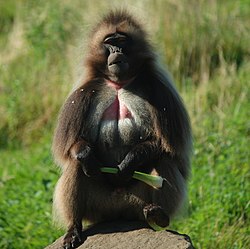
 Macho de Theropithecus gelada | ||
| Taxonomía | ||
| Reino: | Animalia | |
| Filo: | Chordata | |
| Clase: | Mammalia | |
| Orden: | Primates | |
| Suborden: | Haplorrhini | |
| Infraorden: | Simiiformes | |
| Parvorden: | Catarrhini | |
| Familia: | Cercopithecidae | |
| Género: |
Theropithecus I. Geoffroy, 1843 | |
| Especie tipo | ||
|
Macacus gelada Rüppell, 1835 | ||
| Especies | ||
Véase el texto
| ||
| Sinonimia | ||
Gelada Gray, 1843 | ||
Theropithecus es un género de primates catarrinos de la familia Cercopithecidae.[1] Cuenta con una sola especie actual, T. gelada, junto con otras dos, conocidas conjuntamente como babuinos gigantes, ya extintas. Está estrechamente relacionado con el género Papio, al que pertenecen los auténticos babuinos, del que se distingue visualmente por una mata de pelo colorido en el pecho. Hoy en día se encuentran solo en Etiopía y Eritrea, pero el registro fósil indica una amplia distribución en otras épocas, incluyendo el sur, este y norte de África.[2] Además, es conocido en yacimientos en Europa y Asia, como Mirzapur (India), Ubeidiya (Israel), Pirro Nord (Italia) y Cueva Victoria (España).[2]
Especies
Referencias
- ↑ Groves, Colin (2005). Wilson, D. E.; Reeder, D. M., eds. Mammal Species of the World (3ª edición). Baltimore: Johns Hopkins University Press. p. 155. ISBN 0-8018-8221-4.
- ↑ a b Van der Made, J. (2005). «La fauna del Plio-Pleistoceno». En Carbonell, E. (coord.), ed. Homínidos: las primeras ocupaciones de los continentes. Barcelona, España: Editorial Ariel. p. 784. ISBN 84-344-6789-5.
Enlaces externos
 Wikimedia Commons alberga una categoría multimedia sobre Theropithecus.
 Wikispecies tiene un artículo sobre Theropithecus.


| Control de autoridades |
|
|---|

 Datos: Q9087293
- Multimedia: Theropithecus / Q9087293
- Especies: Theropithecus
Content Disclaimer
Informasi ini disarikan dari Wikipedia dan disajikan kembali untuk tujuan edukasi. Konten tersedia di bawah lisensi CC BY-SA 3.0. Kami tidak bertanggung jawab atas ketidakakuratan data yang bersumber dari kontribusi publik tersebut.
- The information displayed on this website is sourced in part or in whole from Wikipedia and has been adapted for the purpose of restating it. We strive to provide accurate and relevant information, however:
- There is no guarantee of absolute accuracy. Wikipedia is an open, collaborative project that can be edited by anyone, so information is subject to change.
- It is not intended to constitute professional advice. The content displayed is for informational and educational purposes only. For important decisions (e.g., medical, legal, or financial), please consult a professional.
- Content copyright. Wikipedia is licensed under the Creative Commons Attribution-ShareAlike License (CC BY-SA). This means that content may be reused with appropriate attribution and shared under a similar license.
- Responsible use. Any risk arising from the use of information from this website is entirely the responsibility of the user.