Trypetheliales
Trypetheliales es un orden de hongos de la clase Dothideomycetes. La mayoría de las especies del orden forman líquenes, aunque algunas son hongos liquenícola…
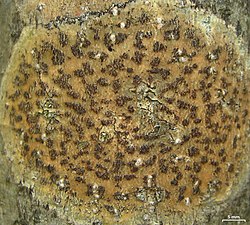
| Trypetheliales | ||
|---|---|---|
.jpg) | ||
| Taxonomía | ||
| Dominio: | Eukaryota | |
| Reino: | Fungi | |
| División: | Ascomycota | |
| Clase: | Dothideomycetes | |
| Orden: |
Trypetheliales Lücking, Aptroot y Sipman (2008) | |
Trypetheliales es un orden de hongos de la clase Dothideomycetes. La mayoría de las especies del orden forman líquenes, aunque algunas son hongos liquenícolas. Trypetheliales contiene dos familias, Polycoccaceae y Trypetheliaceae. El orden fue circunscrito en 2008 por los liquenólogos Robert Lücking, André Aptroot y Harrie Sipman.[1]
Familias y géneros
A partir de octubre de 2021, Index Fungorum, acepta 2 familias, 25 géneros y 478 especies dentro de Trypetheliales:[2]
- Polycoccaceae Ertz, Hafellner & Diederich (2015)[3]
- Clypeococcum – ca. 10 spp.
- Polycoccum – ca. 60 spp.
- Trypetheliaceae Eschw. (1824)[4]
- Alloarthopyrenia – 1 sp.
- Aptrootia – 3 spp.
- Architrypethelium – 8 spp.
- Astrothelium – ca. 275 spp.
- Bathelium – 16 spp.
- Bogoriella – 29 spp.
- Buscalionia – 1 sp.
- Constrictolumina – 9 spp.
- Dictyomeridium – 7 spp.
- Distothelia – 3 spp.
- Laurera – 2 spp.
- Marcelaria – 3 spp.
- Musaespora – 2 spp.
- Mycomicrothelia – 8 spp.
- Nigrovothelium – 3 spp.
- Novomicrothelia – 1 sp.
- Polymeridium – 51 spp.
- Polypyrenula – 1 sp.
- Pseudopyrenula – 21 spp.
- Trypethelium – 16 spp.
- Viridothelium – 11 spp.
Referencias
- ↑ Aptroot, André; Lücking, Robert; Sipman, Harrie J.M.; Umana, Loengrin; Chaves, José Luis (2008). Pyrenocarpous lichens with bitunicate asci. A first assessment of the lichen biodiversity inventory in Costa Rica. Bibliotheca Lichenologica 97. Berlin; Stuttgart: J. Cramer. p. 13. ISBN 978-3-443-58076-6.
- ↑ Source dataset. Species Fungorum Plus: Species Fungorum for CoL+. «Trypetheliales». Catalogue of Life Version 2021-09-21. Consultado el 27 de octubre de 2021.
- ↑ Ertz, Damien; Diederich, Paul; Lawrey, James D.; Berger, Franz; Freebury, Colin E.; Coppins, Brian; Gardiennet, Alain; Hafellner, Josef (2015). «Phylogenetic insights resolve Dacampiaceae (Pleosporales) as polyphyletic: Didymocyrtis (Pleosporales, Phaeosphaeriaceae) with Phoma-like anamorphs resurrected and segregated from Polycoccum (Trypetheliales, Polycoccaceae fam. nov.)». Fungal Diversity 74: 53-89. doi:10.1007/s13225-015-0345-6.
- ↑ Eschweiler, F.G. (1824). Systema Lichenum, Genera Exhibens rite distincta, Pluribus Novis Adaucta (en latín). Nuremberg: sumptibus J.L. Schrag. pp. 1-26.
| Control de autoridades |
|
|---|


 Datos: Q10705479
 Multimedia: Trypetheliales / Q10705479
 Especies: Trypetheliales
Content Disclaimer
Informasi ini disarikan dari Wikipedia dan disajikan kembali untuk tujuan edukasi. Konten tersedia di bawah lisensi CC BY-SA 3.0. Kami tidak bertanggung jawab atas ketidakakuratan data yang bersumber dari kontribusi publik tersebut.
- The information displayed on this website is sourced in part or in whole from Wikipedia and has been adapted for the purpose of restating it. We strive to provide accurate and relevant information, however:
- There is no guarantee of absolute accuracy. Wikipedia is an open, collaborative project that can be edited by anyone, so information is subject to change.
- It is not intended to constitute professional advice. The content displayed is for informational and educational purposes only. For important decisions (e.g., medical, legal, or financial), please consult a professional.
- Content copyright. Wikipedia is licensed under the Creative Commons Attribution-ShareAlike License (CC BY-SA). This means that content may be reused with appropriate attribution and shared under a similar license.
- Responsible use. Any risk arising from the use of information from this website is entirely the responsibility of the user.