Condition de Samuelson
La condition de Samuelson, énoncée par Paul Samuelson, dit qu'une production optimale de bien public pur exige l'égalité entre la somme des taux marginaux d…

La condition de Samuelson, énoncée par Paul Samuelson, dit qu'une production optimale de bien public pur exige l'égalité entre la somme des taux marginaux de substitution et le taux de transformation des produits.
Formalisation mathématique
Soit le bien public et () les biens privés. La fonction de production sous forme implicite est donnée par l'expression suivante: où est la quantité produite du bien j.




Les fonctions d'utilité sont:

où est la quantité du bien j consommée par l’individu i. Il n'y a pas d'indice i pour la quantité consommée du bien public car elle est la même pour tout le monde. Par contre, chaque individu consomme une quantité de bien privé qui dépend de ses préférences et de son revenu.

Un état de rendement social maximum peut être obtenu en maximisant l'utilité du premier consommateur sous les contraintes usuelles. Le lagrangien est:

où sont les multiplicateurs de Lagrange et est le stock du bien j.


Les conditions de premier ordre sont:






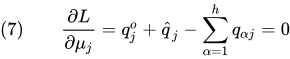
En éliminant les multiplicateurs de Lagrange, on obtient:
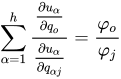

Lorsque l'on prend les trois quantités consommées , et , on peut écrire:

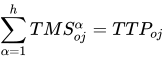

La deuxième relation, relative aux biens privés j et s, est identique à celle obtenue dans l'économie du bien-être. Les taux marginaux de substitution (TMS) doivent être égaux aux taux de transformation des produits (TTP). La première relation nous donne la condition d'optimalité pour le bien public. La somme des taux marginaux de substitution (entre le bien public et un bien privé quelconque) de tous les consommateurs doit être égale au taux de transformation des produits.
Bibliographie
- Michael Pickhardt: Fifty Years after Samuelson’s “The Pure Theory of Public Expenditure”: What are we Left With? In: Journal of the History of Economic Thought. 28, Nr. 4, 2006, S. 439–460.
- Agnar Sandmo: Public Goods. In: Steven N. Durlauf and Lawrence E. Blume (Eds.): The New Palgrave Dictionary of Economics. Palgrave Macmillan, Internet http://www.dictionaryofeconomics.com/article?id=pde2008_P000245&edition=current#sec1 (Online-edition).
- Paul Samuelson: The Pure Theory of Public Expenditure. In: The Review of Economics and Statistics. 36, Nr. 4, 1954, S. 387–389.
Voir aussi

Content Disclaimer
Informasi ini disarikan dari Wikipedia dan disajikan kembali untuk tujuan edukasi. Konten tersedia di bawah lisensi CC BY-SA 3.0. Kami tidak bertanggung jawab atas ketidakakuratan data yang bersumber dari kontribusi publik tersebut.
- The information displayed on this website is sourced in part or in whole from Wikipedia and has been adapted for the purpose of restating it. We strive to provide accurate and relevant information, however:
- There is no guarantee of absolute accuracy. Wikipedia is an open, collaborative project that can be edited by anyone, so information is subject to change.
- It is not intended to constitute professional advice. The content displayed is for informational and educational purposes only. For important decisions (e.g., medical, legal, or financial), please consult a professional.
- Content copyright. Wikipedia is licensed under the Creative Commons Attribution-ShareAlike License (CC BY-SA). This means that content may be reused with appropriate attribution and shared under a similar license.
- Responsible use. Any risk arising from the use of information from this website is entirely the responsibility of the user.