DIIS
DIIS (英: direct inversion in the iterative subspace または direct inversion of the iterative subspace) は Pulay 混合 としても知られる外挿�…

 |
DIIS (英: direct inversion in the iterative subspace または direct inversion of the iterative subspace) は Pulay 混合 としても知られる外挿技術である。計算量子化学の分野において、ハートリー・フォック自己無撞着場法の収束を加速および安定化するためにピーター・ピューレイにより開発された[1][2]。
この手法では、イテレーションごとに、前回のイテレーションで得られた推定誤差ベクトルの線形結合が計算される。線形結合の係数は、最小二乗の意味において零ベクトルに最も近付くように決定される。新しく決定された係数を用いて、次のイテレーションで用いる変分関数を外挿する。
詳細
各イテレーションにおいて、推定誤差ベクトル ei を決定する。このベクトルは変分値 pi に対応するものとする。十分な回数イテレーションを行なった後、以前の m 回分のイテレーションの誤差ベクトルの線形結合を次のようにとる。
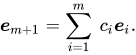
DIIS法では、 em+1 のノルムを、係数の総和が1という拘束条件のもとで最小化する。係数の総和を1とする理由は、試行ベクトルを厳密解 (pf) と誤差ベクトルの和として書けば理解できるであろう。DIISの近似の元では、次のように書ける。

したがって、厳密解を求めるためには係数の総和が1でなくてはならず、その上で第二項を最小化しなければならない。最小化はラグランジュの未定乗数法により行うことができる。未定乗数 λ を導入し、ラグランジアンを次のように構成する。
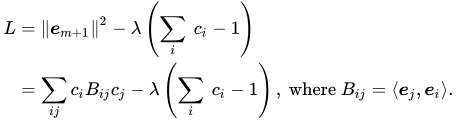
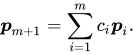
全ての係数および未定乗数についての L の偏微分係数をゼロとすることにより (m + 1) 本の線形方程式系が得られ、m 個の係数(と未定乗数)について解かれる。こうして得られた係数を用いて、変分関数を次のように更新する。
出典
- ^ Pulay, Péter (1980). “Convergence acceleration of iterative sequences. the case of SCF iteration”. Chemical Physics Letters 73 (2): 393–398. doi:10.1016/0009-2614(80)80396-4.
- ^ Pulay, Péter (1982). “Improved SCF Convergence Acceleration”. Journal of Computational Chemistry 3 (4): 556–560. doi:10.1002/jcc.540030413.
参照文献
- Garza, Alejandro J. (2012). “Comparison of self-consistent field convergence acceleration techniques”. Journal of Chemical Physics 173 (5): 054110. doi:10.1063/1.4740249.
- Rohwedder, Thorsten (2011). “An analysis for the DIIS acceleration method used in quantum chemistry calculations”. Journal of Mathematical Chemistry 49 (9): 1889. doi:10.1007/s10910-011-9863-y.
外部リンク
Content Disclaimer
Informasi ini disarikan dari Wikipedia dan disajikan kembali untuk tujuan edukasi. Konten tersedia di bawah lisensi CC BY-SA 3.0. Kami tidak bertanggung jawab atas ketidakakuratan data yang bersumber dari kontribusi publik tersebut.
- The information displayed on this website is sourced in part or in whole from Wikipedia and has been adapted for the purpose of restating it. We strive to provide accurate and relevant information, however:
- There is no guarantee of absolute accuracy. Wikipedia is an open, collaborative project that can be edited by anyone, so information is subject to change.
- It is not intended to constitute professional advice. The content displayed is for informational and educational purposes only. For important decisions (e.g., medical, legal, or financial), please consult a professional.
- Content copyright. Wikipedia is licensed under the Creative Commons Attribution-ShareAlike License (CC BY-SA). This means that content may be reused with appropriate attribution and shared under a similar license.
- Responsible use. Any risk arising from the use of information from this website is entirely the responsibility of the user.